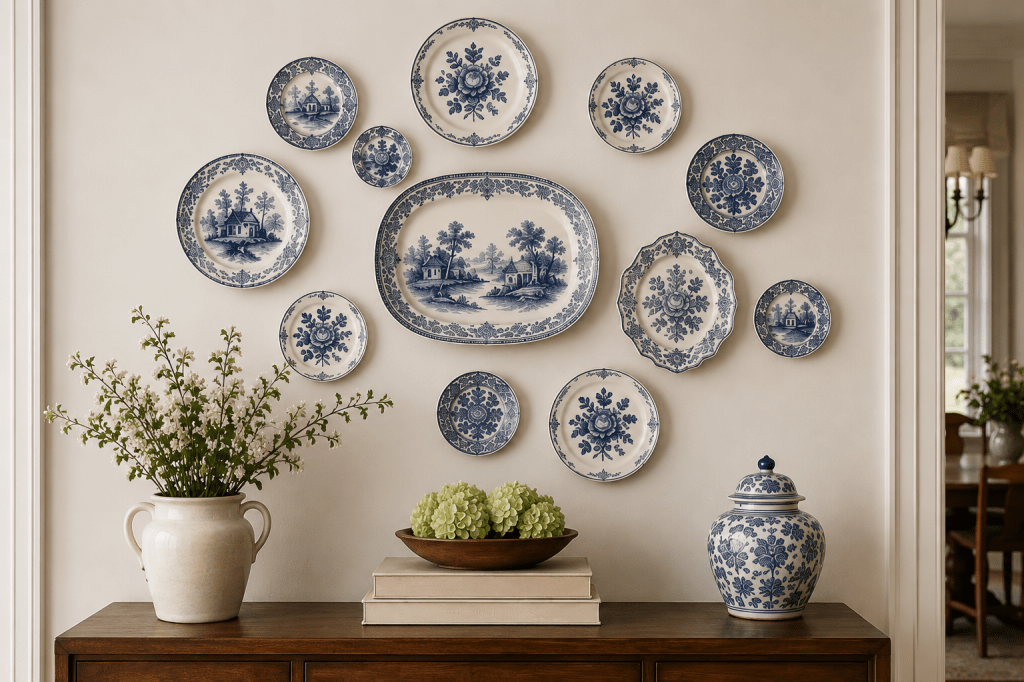
“The story doesn’t have to exist before the collection begins. Sometimes the collection becomes the story.”
Every family seems to have a cabinet of family treasures. Maybe it’s a china cabinet in the dining room that hasn’t been opened in years. Maybe it’s a hutch inherited from a grandparent, tucked into a corner and filled with dishes reserved for special occasions. Or perhaps it’s a kitchen cabinet holding a mismatched collection gathered over decades—pieces from weddings, vacations, antique shops, and family homes that no one quite wanted to part with.
For many of us, plates are more than plates. They are reminders of holiday dinners, Sunday lunches, and the people who sat around the table before us. They carry stories, even when we can’t quite remember where every piece came from. Perhaps that’s why I’ve always been drawn to plate walls.
Unlike artwork purchased all at once from a store, a plate wall often feels personal. It looks collected rather than decorated. It tells a story, even before anyone knows what that story is. And while plate walls may be having a moment in decorating circles again, the truth is they’ve never really gone out of style. Traditional homes, cottages, historic houses, and welcoming family kitchens have been displaying cherished dishes on their walls for generations.
As I’ve researched plate walls and paid attention to the ones that linger in my memory, I’ve noticed that the most beautiful arrangements are rarely the most complicated. They’re simply thoughtful. They feel as though they belong in the room. If you’ve admired plate walls but never quite known where to begin, here’s what I’ve learned along the way.
Start With the Space, Not the Plates
If you’re anything like me, the temptation is to start shopping immediately. After all, choosing plates is the fun part. But the more I’ve studied plate walls in homes I admire, the more I’ve realized that the room itself should guide many of the decisions.
A plate wall works best in spaces that already feel like natural gathering places. Dining rooms, breakfast nooks, kitchens, hallways, and entryways are all wonderful options because they are places people pass through, linger in, and remember. There is something fitting about displaying meaningful objects in spaces that are already filled with everyday life.
Before choosing a single plate, spend a little time looking at the wall itself. Is it a large blank space above a buffet? A cozy corner in a breakfast nook? A hallway that feels as though it’s missing a bit of personality? Understanding what the wall needs often makes the rest of the decisions much easier.
Choosing Plates That Feel Collected
One of the things that surprised me when I began paying attention to plate walls is how rarely the pieces match perfectly. Of course, a coordinated set can be beautiful. A collection of blue-and-white transferware or traditional floral china creates an elegant, timeless look and can be an excellent place to start. In fact, for someone building a plate wall from scratch, a coordinated collection often removes a lot of the guesswork. But matching isn’t what creates charm.
Many of the plate walls I’m most drawn to seem to have evolved naturally over time. A platter found at an antique shop hangs beside a piece inherited from a grandmother. A favorite thrift store discovery sits near something purchased on a family vacation years ago. The patterns may differ slightly. The shapes may not match exactly. Yet somehow the collection feels more interesting because of those differences. The common thread isn’t perfection. It’s personality.
Whether your plates come from family collections, flea markets, estate sales, antique stores, or a newly purchased set, what matters most is creating a collection that feels meaningful to you.
Before You Touch a Hammer
If there’s one piece of advice that appears in nearly every plate wall tutorial I’ve encountered, it’s this: create a paper template first. I’ll admit that it sounds a little tedious when you’re eager to see the finished result. But the more I’ve experimented with layouts, the more I understand why people recommend it. Tracing each plate onto kraft paper allows you to test the arrangement before committing to nail holes. You can move pieces around, evaluate spacing, and see the display at its actual size. Better yet, you can walk across the room and look at the arrangement from a distance, which is often when you notice what needs adjusting. It’s one of those simple steps that feels unnecessary until you try it. Then it becomes difficult to imagine working without it.
Choosing How to Hang Your Plates
Once the layout begins to take shape, the next decision is how the plates will actually be displayed on the wall.
When I first started looking into plate walls, I assumed there must be one “correct” method that everyone used. What I discovered instead is that most people choose the approach that feels right for their particular collection.
Traditional wire plate hangers have been around for generations and remain popular for good reason. They’re affordable, easy to find, and allow plates to be removed or rearranged later if you decide to make changes. If you’re working with heirloom pieces or a collection that may continue to evolve, that flexibility can be appealing.
Adhesive disc hangers offer a different look altogether. Because they attach to the back of the plate, they remain hidden once the piece is hanging on the wall. Many of the magazine-worthy plate walls that inspire so many of us use this method because it allows the eye to focus entirely on the plates themselves. If you use this method, be sure to follow the directions exactly. It can make the difference between beautifully displayed treasures and broken heirlooms.
As with so many decorating decisions, there isn’t a universally right answer. Some people prefer the flexibility of wire hangers. Others appreciate the cleaner appearance of adhesive discs. The important thing is choosing a method that feels secure and appropriate for the pieces you’re displaying.
Bringing the Arrangement to Life
There comes a moment in every decorating project when planning gives way to action. The templates are taped to the wall. The hammer comes out. Suddenly the wall that has existed only in your imagination begins to take shape in real life.
If possible, start with the largest piece in the arrangement. Whether it’s a platter, charger, or oversized dinner plate, that piece often serves as a visual anchor for everything that follows. Once it’s in place, the surrounding plates tend to find their positions more naturally.
One thing I’ve noticed when looking at rooms I love is that the people who create them seem comfortable taking their time. They aren’t rushing toward a finished product. They’re paying attention. That’s good advice for a plate wall as well. Hang a few pieces. Step back. Look at the arrangement from across the room. Sit down in a nearby chair and see how it feels from a different perspective. Sometimes a plate that seemed perfectly placed while standing on a ladder looks slightly crowded once viewed from across the room. The beauty of decorating is that small adjustments often make a remarkable difference.
A Few Things I’ve Learned Along the Way
As I’ve studied plate walls and gathered inspiration for my own home, a few themes seem to appear again and again. The first is that breathing room matters. When people begin collecting plates for a display, there’s often a temptation to use every available inch of wall space. After all, if ten plates look good, surely twelve would look even better. And sometimes that’s true. But more often, the arrangements that feel calm and inviting leave a little space between pieces. That space allows the eye to appreciate the individual details that make each plate special. It prevents the display from feeling crowded or overwhelming.
If there’s one decorating principle that seems to appear again and again in plate walls I admire, it’s variety. Using different sizes creates movement and interest in a way that matching patterns alone never can. A large platter naturally draws the eye and gives the arrangement a sense of structure. Smaller plates provide balance and help fill spaces without making the display feel heavy. When every plate is exactly the same size, the arrangement can sometimes feel a little predictable. Introducing variation gives the eye somewhere to travel.
Another thing I found particularly helpful was studying photographs of plate walls that felt welcoming and natural. The ones I liked best weren’t necessarily symmetrical. They were balanced. That’s an important distinction. Balance allows different elements to work together comfortably. Symmetry asks everything to be identical. For many traditional homes, balance often feels warmer. There’s certainly nothing wrong with symmetry. It can be beautiful in the right setting. Yet many of the plate walls that linger in my memory aren’t symmetrical at all. Instead, they’re balanced.
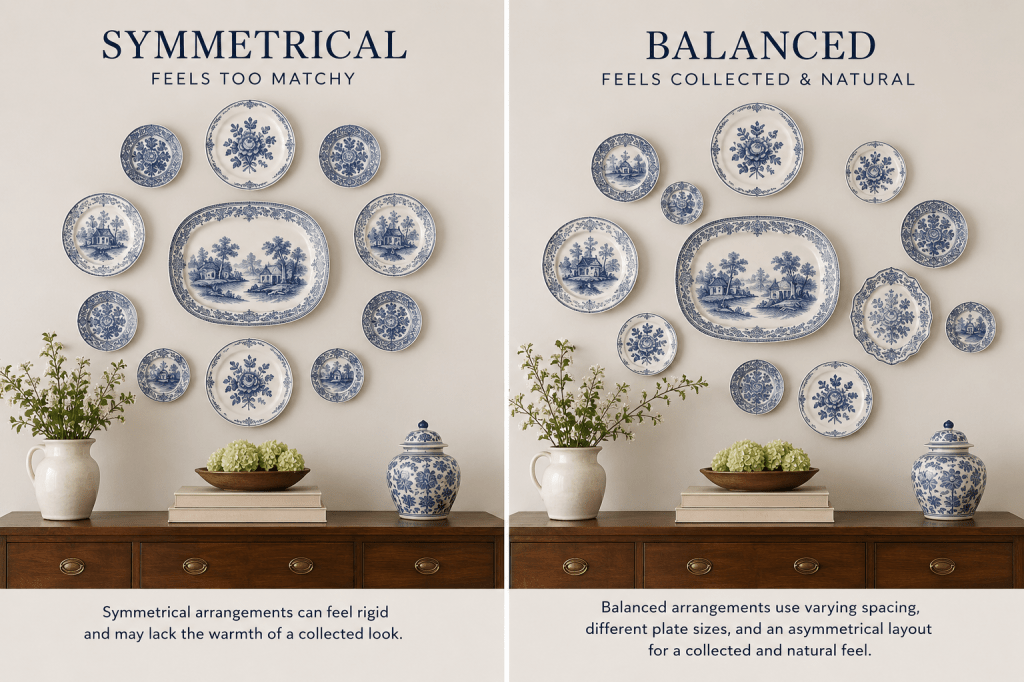
A large platter on one side may be offset by several smaller plates on the other. The arrangement feels comfortable without being identical. It feels collected rather than calculated. For traditional homes especially, balance often creates a warmth that perfect symmetry sometimes lacks. Perhaps most importantly, I’ve learned that a plate wall doesn’t have to be finished all at once. Some collections come together over a weekend. Others take years. There is no deadline.
If You’re Starting With Nothing
It’s easy to look at a finished plate wall and assume the homeowner inherited generations of beautiful china. Sometimes that’s true. But often, collections begin with a single piece. A platter found at an antique store. A plate discovered at a flea market. A thrift store treasure that cost less than lunch. Over time, one piece becomes three. Three become six. Before long, a collection begins to emerge.
For those who don’t already have family china tucked away in a cabinet somewhere, there’s no reason not to start with a coordinated set. In fact, that can be one of the easiest ways to create a cohesive display. As the years pass, those original pieces can be joined by vacation finds, inherited treasures, and unexpected discoveries. The story doesn’t have to exist before the collection begins. Sometimes the collection becomes the story.
More Than Decoration
I suspect that’s what draws me to plate walls in the first place. They remind us that homes are built slowly. Not just the walls and furniture, but the layers of meaning that make a space feel personal. A plate wall may begin as a decorating project, but over time it often becomes something more. The pieces start to carry memories. A platter reminds you of an anniversary trip. A plate belonged to a grandmother. Another came from an antique store on a rainy Saturday afternoon.
Eventually, the display becomes less about decorating and more about remembering.
When guests stop to admire a plate wall, the conversation rarely stays focused on design for very long. Someone asks where a piece came from. A story is shared. Another memory surfaces. Before long, people are talking about family, travel, traditions, and the homes they’ve loved.
The plates simply provide a place for those stories to live. And perhaps that’s why they continue to resonate generation after generation. They’re beautiful, certainly. But they’re also meaningful. And when a home contains things that are both beautiful and meaningful, it begins to tell a story all its own.
My Favorite Plate Wall Finds
If you’re ready to start your own plate wall, I’ve gathered some of my favorite plates, platters, hanging supplies, planning tools, and installation essentials on my Amazon storefront.
Whether you’re beginning with family heirlooms, thrift store discoveries, or a coordinated collection purchased specifically for your home, I hope these ideas help you create a display that feels welcoming, personal, and uniquely yours.
After all, the most memorable plate walls aren’t necessarily the most expensive or the most perfectly arranged. They’re the ones that feel like they belong exactly where they are.


 Stories of Home | Char Beyond the Bell
Leave a comment